Stefano Riva’s Webpage
Current position: Research Scientist at Autodesk Research in Physics-Informed AI/ML
I am Stefano Riva, a Research Scientist working on physics-informed machine learning for simulation and design. My research develops methods that combine high-fidelity physics-based models with data-driven AI to make complex engineering simulations faster, more reliable, and more useful in real design workflows.
At Autodesk Research (π-Labs, London), I focus on bridging traditional numerical solvers and modern ML — reduced-order models, state estimation, and scientific machine learning — for advanced simulation and design applications. My background is in reduced-order modelling, data assimilation, and multi-physics simulation, with extensive validation on nuclear, fluid dynamics, and energy systems.
I contribute to open-source tools including pyforce, PySHRED, and ctf4science, which support model reduction, sparse sensing, and rigorous benchmarking of scientific ML methods.
Highlights
2026
- Research Scientist — Physics-Informed AI, Autodesk Research (π-Labs), London (from April)
- 2nd Prize, Italian PhD Nuclear Talent Award, Associazione Italiana Nucleare (March)
- Journal articles on state estimation with Shallow Recurrent Decoders (Chemical Engineering Science), the pyforce package (Journal of Open Source Software), and adaptive GEIM on the DYNASTY facility (Nuclear Engineering and Technology)
- Preprints on multi-fidelity SHRED and the CTF4Nuclear benchmark framework
- Contributions to PHYSOR 2026 (Turin) on SHRED-based state estimation and multi-fidelity learning
2025
- Postdoctoral Researcher, Department of Energy, Politecnico di Milano — ROM for two-phase flow in collaboration with Eni Spa (Aug – Mar 2026)
- PhD cum laude, Energy and Nuclear Science and Technology, Politecnico di Milano (Oct)
- ENEN PhD Prize, European Nuclear Education Network (May)
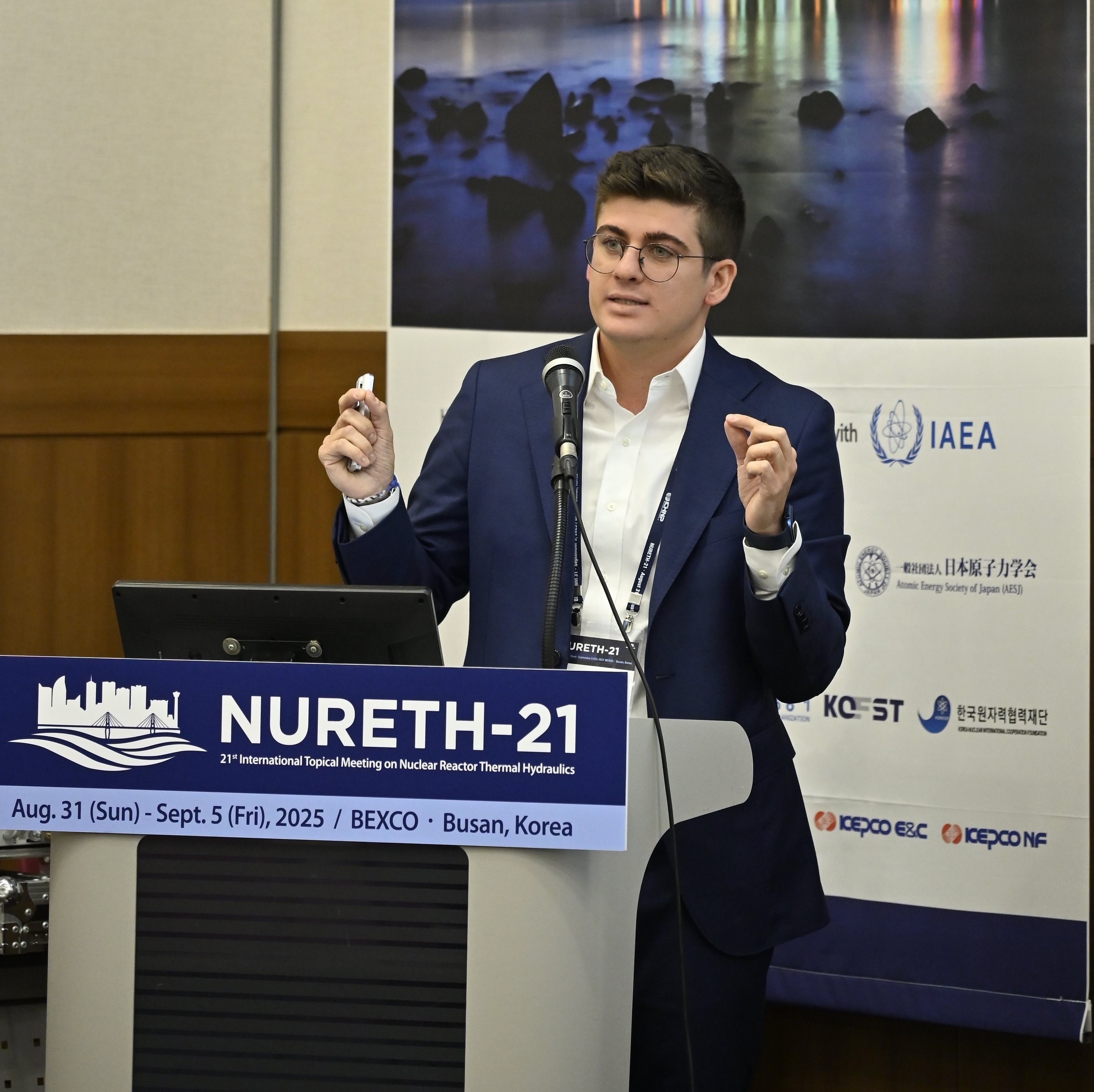
- Young Professional Award, NURETH-21, Busan (September)
- Best Research Contribution Award (co-author), SCOPE2 Conference, Dhahran (November)
- Common Task Framework papers at NeurIPS (Datasets & Benchmarks) and ICLR
- Journal articles on SHRED state estimation (Progress in Nuclear Energy), parametric DMD (Nuclear Technology), and MHD reduced-order modelling (Fusion Engineering and Design)
2024
- VISIT Intern, University of Washington, Seattle — SHRED networks for nuclear state estimation (Oct – Mar 2025)
- Best Student Paper Award, NUTHOS-14, Vancouver (August)
- Young Author Award (co-author), NENE2024, Portorož (September)
- Qualification to practice the Engineering Profession, Milan (March)
- Journal articles on multi-physics model correction (Applied Mathematical Modelling), incompressible Schrödinger flow (Physics of Fluids), and OpenMC–FEniCSx coupling (Nuclear Engineering and Design)
2023
- Best Paper Award, ICAPP-2023, Gyeongju (April)
- Teaching Assistant, Fission Reactor Physics 1, Politecnico di Milano
- Journal articles on hybrid data assimilation (GEIM, PBDW) and GEIM stabilization (Annals of Nuclear Energy, Computer Methods in Applied Mechanics and Engineering)
2022
- Best Master Thesis in Engineering, Cultural Association CISE2007 (September)
- Started PhD in Energy and Nuclear Science and Technology, Politecnico di Milano (May)
- First conference contributions on hybrid data assimilation (NUTHOS) and incompressible Schrödinger flow (NENE)
2021
- Master’s degree cum laude, Nuclear Engineering, Politecnico di Milano
2019
- Bachelor’s degree, Energy Engineering, Politecnico di Milano
Research Interests
- Physics-informed machine learning for simulation and design
- Reduced-order models and data assimilation
- Scientific machine learning for fluid dynamics and multi-physics systems
- Bridging high-fidelity solvers with data-driven state estimation
- Computational methods for engineering applications
PhD Thesis
📘 PhD Repository: github.com/Steriva/PhD-Thesis
Title: Advanced Data-Driven Techniques for State Estimation in Nuclear Reactors
Supervisors: Prof. Antonio Cammi, Dr. Carolina Introini, Prof. J. Nathan Kutz
During my PhD at Politecnico di Milano (2022–2025), I developed fast and reliable state estimation methods that combine physics-based models with data-driven techniques. The core challenge was inferring full system states from sparse and indirect measurements — a problem common across simulation and design, from reactors to complex engineered systems.
I integrated Reduced Order Modelling (ROM) and Data Assimilation for real-time computation, and explored Shallow Recurrent Decoder (SHRED) networks to capture nonlinear dynamics and model discrepancies efficiently. Methods were validated on the Molten Salt Fast Reactor (MSFR), the TRIGA Mark II research reactor, and the DYNASTY experimental facility.